
What happens when a student can ask AI almost anything but cannot tell whether its answer is correct?
That’s exactly the challenge modern education needs to address.
Artificial intelligence is becoming part of everyday life, and the UAE is taking an important step towards preparing young people for this changing world. Rather than simply teaching students how to use AI tools, the country is helping them understand how AI works, question its outputs, recognize its limitations, and use it responsibly.
From introducing AI as a school subject to investing in teacher development and interactive learning platforms, the UAE is building something bigger than a curriculum: a connected AI literacy ecosystem designed for the next generation.
Let’s explore how the UAE is bringing these efforts together to prepare students for an AI-driven future.
Why Is AI Literacy Becoming a Priority in UAE Education?
Students today can use AI to generate answers, explore ideas, and complete everyday tasks. But can they recognize when those answers are incorrect? Do they understand how AI learns from data or why its responses may contain bias?
These questions are shaping the UAE’s approach to AI education.
In 2025, the UAE Ministry of Education announced that artificial intelligence would be introduced as an official subject in public schools, from Kindergarten through Grade 12.
The curriculum focuses on several key areas:
- Foundational AI concepts and understanding.
- Data, algorithms, and how AI systems work.
- Ethical awareness and responsible technology use.
- Real-world applications and problem-solving.
- Innovation and project design.
- AI-related policies and governance.
The objective goes beyond teaching students how to interact with AI tools. It is about developing the knowledge and judgment needed to use these technologies responsibly.
From Discovering AI to Designing With It
AI literacy is not something students can develop through a few lessons on writing prompts. It requires a structured learning journey that evolves with their age and understanding.
Building AI Awareness at an Early Age
For younger children, learning begins with simple concepts. They explore how machines follow instructions, how humans create technology, and how AI can recognize patterns.
As students progress, they begin asking more challenging questions.
- How does AI learn from data?
- Why does it sometimes make mistakes?
- Can AI-generated information be biased?
- How do large language models work, and when should you trust their responses?
Eventually, students move towards evaluating AI systems, developing AI-supported solutions, and understanding the responsibilities involved in designing intelligent technologies.
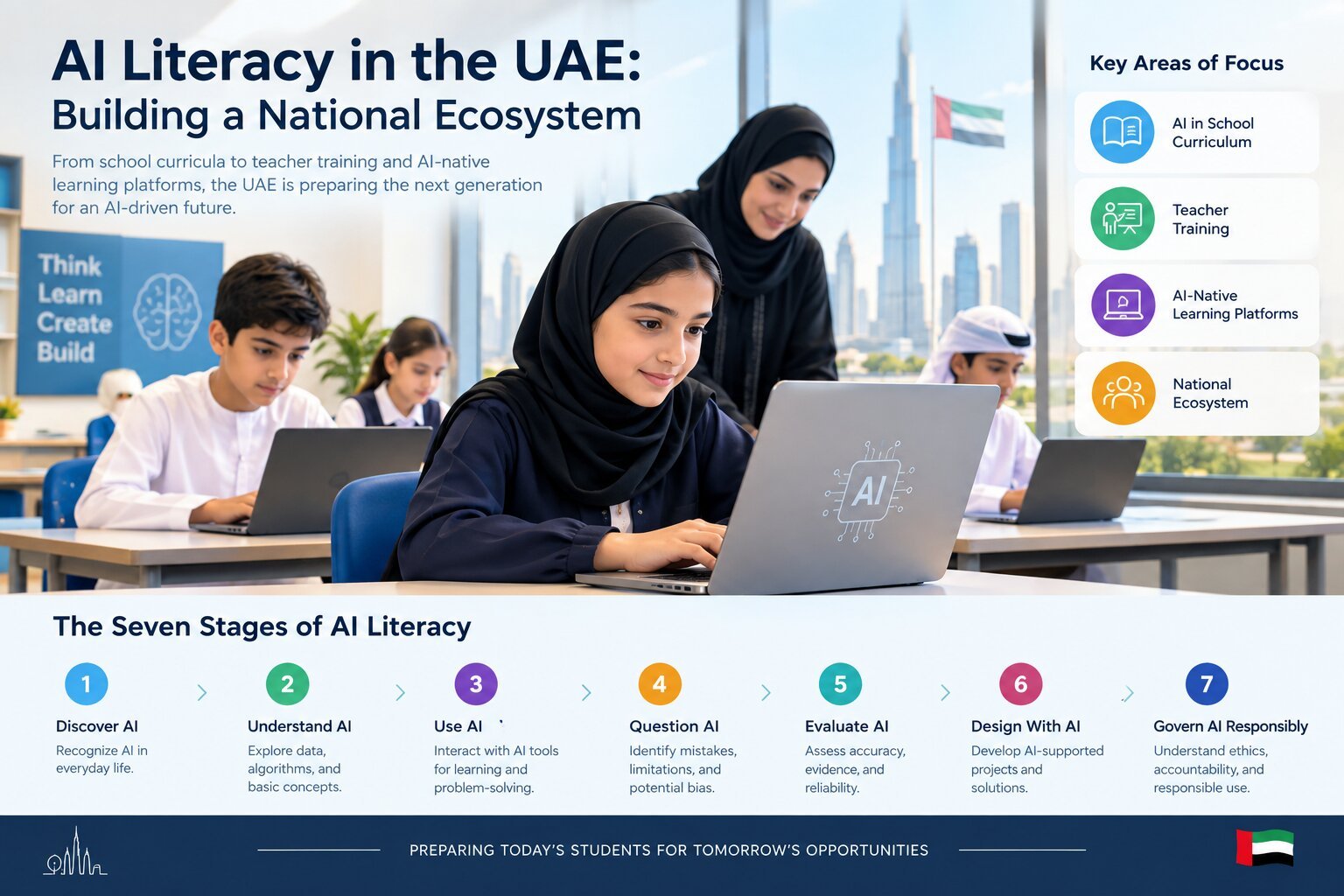
The Seven Stages of AI Literacy
| Learning Stage | What Students Learn |
| Discover AI | Recognize AI in everyday life. |
| Understand AI | Explore data, algorithms, and basic concepts. |
| Use AI | Interact with AI tools for learning and problem-solving. |
| Question AI | Identify mistakes, limitations, and potential bias. |
| Evaluate AI | Assess accuracy, evidence, and reliability. |
| Design With AI | Develop AI-supported projects and solutions. |
| Govern AI Responsibly | Understand ethics, accountability, and responsible use. |
This progression helps students develop critical thinking rather than becoming dependent on technology they do not fully understand.
Abu Dhabi: Expanding AI Literacy Across Private Schools
Abu Dhabi is contributing to this educational transformation through its Department of Education and Knowledge (ADEK).
Its AI Literacy initiative is being implemented across more than 170 private schools, progressively developing students’ capabilities from Kindergarten through Grade 12.
How the Learning Approach Works
Younger students begin with age-appropriate activities that encourage logical thinking, curiosity, and problem-solving.
As they advance, students gradually learn to:
- Interact with AI tools.
- Examine and evaluate AI-generated responses.
- Develop AI-supported solutions.
- Understand responsible AI use and governance.
Teacher preparation is equally important. The initiative includes professional development, lesson materials, assessment guidance, and implementation support.
This reflects a broader principle: successful AI literacy requires more than access to technology. Schools also need effective curricula, trained teachers, appropriate teaching methods, governance, and suitable learning environments.
Dubai: Bringing AI Literacy Into Different Subjects
Dubai is developing another approach that connects artificial intelligence with everyday classroom learning.
The Knowledge and Human Development Authority (KHDA), DP World Foundation, and MIT RAISE have launched a multi-year AI literacy program for Dubai private schools, initially focusing on Grades 6–8.
A Cross-Curricular Approach to AI Education
Rather than limiting AI education to computing classes, the program introduces AI concepts across several subjects, including:
- Mathematics
- Science
- Computing
- Art
- English
- Arabic
This approach helps students understand how artificial intelligence connects to different areas of knowledge.
It also reflects an important direction for education: AI literacy is likely to become less of an isolated subject and more of a capability students apply across learning, work, and everyday life.
Something Worth Thinking About
A student who can generate an essay using AI may know how to operate the tool. But can they identify inaccurate information, recognize bias, or explain why two AI systems provide different answers?
That distinction is why teaching AI usage alone is not enough.
Why AI-Literate Teachers Are Essential
Introducing AI into classrooms also means preparing educators to teach it effectively.
The UAE is investing in teacher development through several initiatives.
The Ministry of Education and Hamdan Bin Mohammed Smart University have launched a National AI Upskilling Program for Teachers.
Meanwhile, Alef Education and Microsoft have delivered large-scale AI training to educators across UAE schools. Emirates College for Advanced Education (ECAE) is also contributing to professional learning and teacher capability.
The Teacher’s Role in an AI-Enabled Classroom
AI may help generate explanations or support learning activities, but teachers remain central to the educational experience.
They provide:
- Context and effective teaching methods.
- Guidance when evaluating AI-generated information.
- Human judgment and validation.
- Support for ethical and responsible AI use.
Most importantly, teachers help students understand when to trust, challenge, verify, or ignore an AI response.
Building a Connected AI Literacy Ecosystem in the UAE
Government initiatives provide an important foundation, but meaningful AI education also requires collaboration between curriculum providers, educational institutions, technology companies, and schools.
A growing private-sector ecosystem is helping address these different needs.
Companies such as EDNAS are developing ready-to-teach AI literacy curricula with lesson plans, activities, assessments, and teacher guidance.
Established EdTech providers such as Alef Education contribute digital learning infrastructure and school reach.
Meanwhile, AI-native learning platforms such as Mexty provide another important layer. They help schools structure AI literacy learning paths, create and adapt interactive content, conduct assessments, and provide controlled environments where students can experiment with AI concepts.
Technology organizations, including Presight and AI71, alongside institutions such as MBZUAI and ECAE, contribute technical expertise and educational knowledge to the wider landscape.
How the Different Parts of the Ecosystem Connect
| Ecosystem Component | Role in AI Education |
| Government and regulators | Establish educational priorities and frameworks. |
| Curriculum providers | Define what students should learn. |
| Teacher development institutions | Prepare educators for effective delivery. |
| AI-native learning platforms | Support interactive learning, experimentation, and assessment. |
| AI technology providers | Contribute tools and technical expertise. |
| Schools and educators | Bring these elements together for learners. |
Each component addresses a different requirement. Connecting them helps transform individual initiatives into more coherent learning experiences.
From Learning About AI to Experiencing It
Reading about artificial intelligence is useful, but experiencing how it behaves can make complex concepts easier to understand.
Consider AI hallucinations.
A teacher can explain that AI sometimes generates incorrect information. However, allowing students to examine an inaccurate response, investigate its claims, and verify the facts creates a more practical learning experience.
The same applies to prompting. Students can change instructions, compare generated responses, and observe how context influences AI outputs.
Making AI Learning More Practical
Students can develop a deeper understanding through activities such as:
- Comparing responses from different AI models.
- Testing how prompt changes influence outputs.
- Examining evidence and source reliability.
- Identifying potential bias in generated information.
- Learning when independent verification is necessary.
This creates a role for AI-native learning platforms such as Mexty, which support structured learning experiences where students can interact with AI concepts, experiment with content, and participate in assessments.
The aim is to make AI learning interactive while maintaining appropriate supervision and age-appropriate educational experiences.
Think About This
Imagine two AI models giving different answers to the same question. Which one should a student believe?
Rather than accepting the more convincing response, students should learn to examine the evidence, check source reliability, and understand why the answers may differ.
This is where practical experimentation helps develop critical thinking.
Beyond Using AI: What Does True AI Literacy Mean?
One of the biggest challenges in AI education is confusing familiarity with AI tools with genuine AI literacy.
A student who knows how to ask an AI assistant a question is not necessarily AI literate. True AI literacy involves understanding that AI systems can make mistakes, produce different answers, and reflect limitations in their underlying data or design.
It also means recognizing that outputs depend on training data, model design, prompting, and context.
Students should understand when information needs verification, when bias may be present, and when human judgment remains essential.
The UAE is developing many of the components needed to support this transition. The next challenge is connecting curriculum, teacher capability, governance, learning platforms, and practical experimentation into consistent educational experiences.
The Future of AI Literacy in the UAE
The UAE’s growing AI literacy ecosystem reflects a broader shift in how artificial intelligence is being introduced into education.
National curriculum reforms, Abu Dhabi’s school-level initiatives, Dubai’s cross-curricular program, teacher development, and AI-native learning platforms each contribute to this direction. As these elements become more connected, schools can move beyond simply teaching students how to operate AI tools.
The real objective is to prepare young people who can understand artificial intelligence, question its outputs, evaluate its reliability, design with it, and use it responsibly.
Ultimately, meaningful AI literacy should achieve this: a generation equipped not just to use artificial intelligence, but to make informed decisions about the technology shaping its future.